Le Corbusier Swiss-French, 1887-1965
-
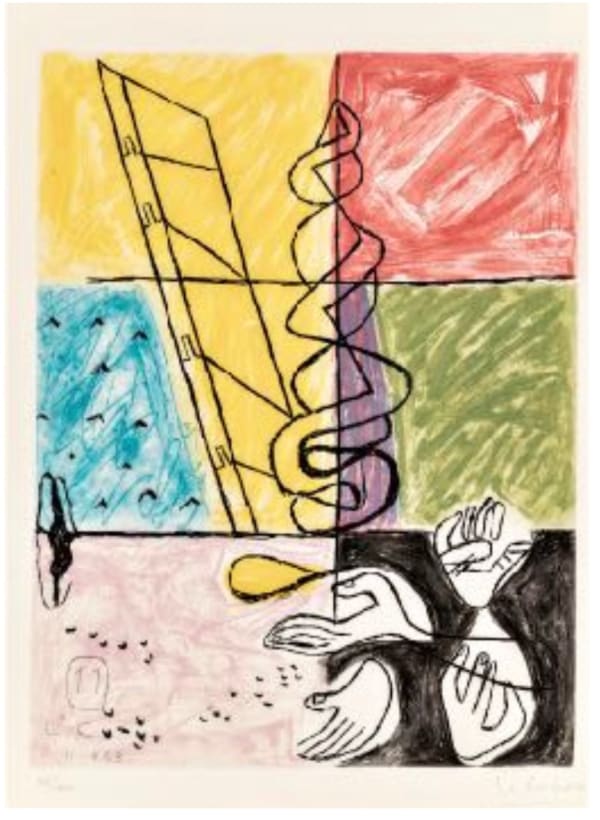
 Le CorbusierUnite (PLANCHE 11), 1953Original Etching & Aquatint57.15 x 45.72cmEdition of 130£ 5,500.00
 -
Le CorbusierUnite (PLANCHE 7), 1953Etching and Aquatint57.15 x 45.72 cmEdition of 130£ 5,500.00


Le Corbusier (1887–1965)
Artist, Architect & Pioneer of Modernism
Le Corbusier, born Charles-Édouard Jeanneret in Switzerland in 1887, is one of the most influential architects and visual artists of the 20th century. A founding figure of Modernism, he transformed not only architecture and urban design but also the language of painting, drawing, and printmaking. His work across disciplines was unified by a belief in harmony, proportion, and the relationship between human beings and the built environment.
Trained as an engraver and watchmaker before turning to architecture, Le Corbusier developed a multidisciplinary vision early in his career. His paintings and prints — produced alongside his architectural practice — reveal the same clarity of form, structural rhythm, and conceptual boldness found in his buildings. Working under the purist movement (Purisme) with Amédée Ozenfant in the 1920s, he pursued a refined visual language grounded in geometry, balance, and order.
Throughout his life, Le Corbusier created a significant body of work in painting, drawing, tapestry, lithography, and sculpture. His imagery often integrates abstracted human forms, symbolic motifs, and architectural geometry, demonstrating his belief that art and architecture were inseparable expressions of modern life. His graphic works, particularly the celebrated lithographs and etchings from the 1940s–1960s, remain highly collected for their inventiveness, clarity, and historical importance.
Internationally renowned for groundbreaking architectural projects such as the Villa Savoye, Unité d’Habitation, Chandigarh, and the Notre-Dame-du-Haut Chapel at Ronchamp, Le Corbusier reshaped the conversation around space, light, and modern living. His Modulor system — a proportional method based on human scale — continues to influence design today.
Le Corbusier died in 1965, leaving behind one of the most extensive and visionary legacies in modern cultural history. His artworks, much like his buildings, endure as powerful statements of modernist thought and remain central to the evolution of 20th-century visual language.